


Stage Lighting Analysis of Uzbekistan's 35th Independence Day Celebration


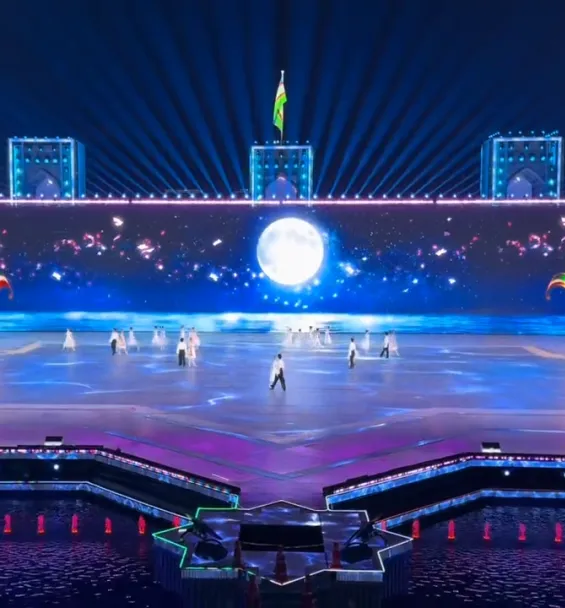
On the night of August 28, 2026, at the New City Center Square in Tashkent. The eight-pointed star stage resembles an unfurled national emblem, and the seven "Pishtaq" arches are awakened by light one after another, while the national flag rises slowly at the top of the central portal. Uzbekistan welcomes the night of its 35th anniversary of independence. On this night, light is not merely illumination; it is a national narrative painted on the canvas of the night sky.


The lighting design team closely followed the celebration theme "With a united homeland and a united people, we will build a new life, a new future!" Taking "Light of the East" as the underlying design logic, they adopted the blue, white, and green of the national flag as the base colors, combined the architectural aesthetics of Samarkand's blue domes, the intricate patterns of traditional textiles, and the radiant light of civilizational fusion along the Silk Road, and used light and shadow to create a visual feast imbued with a national ceremonial sense, an international aesthetic vision, and unique ethnic charm. The entire celebration was divided through the language of light and shadow into three narrative layers: Solemn Tribute, Joyous Celebration, and Future Hope. From warm gold to surging vermilion and emerald green, and then to a gradient of pale pink and light blue, light became the emotional thread running through the entire event, connecting the country's past, present, and future through light and shadow.


PART.01 Stage Design
The Eight-Pointed Star and Seven Arches:
Light Grows Out of Architecture
For the stage of a national-level celebration, a core question often arises: how can cultural symbols transform from "a background to be viewed" into "the subject of the narrative"? The traditional approach treats traditional architectural elements as stage backdrops, illuminated from the outside, with the symbols remaining passive and static. The solution presented by this celebration was to make the architecture itself a luminous body.
The stage design centers on the "eight-pointed star" main performance area, with overall high symmetry. The eight-pointed star is not only a core symbol in Uzbek national patterns but also an ultimate expression of geometric aesthetics. Using it as the stage floor form means there is no longer a single front to the viewing relationship; every angle is a front, and every gaze can reach the visual center.


The most core visual anchor is the seven "Pishtaq" Central Asian classical arches (C1–C7) on the stage. Pishtaq is commonly found on the front facades of Central Asian mosques, madrasas, and ancient city gates. The design team made them three-dimensional and stage-oriented, turning the entire stage into an "architectural national narrative." What the audience sees is not a temporary performance installation but a "city" belonging to Uzbekistan, completed jointly by light and structure.


Inside each of the C1–C7 arches, a large number of pixel strobe bars and framing lights are embedded. Light overflows from within the architecture rather than being illuminated from the outside. The arches are no longer silent scenery but an integral part of the stage's light environment itself; light grows out of the body of the architecture.


C4 is positioned in the center and is the largest in volume, with a rotatable flagpole at its top. After the flag-raising ceremony, the flagpole slowly returns to position through rotation, restoring C4's visual center of gravity to the lighting matrix. The rotation trajectory must avoid the installation points of the FINE 6019 PIXIE IP and FINE 600LH BSWF IP at the top, and the cable routing must be coordinated with the rotation axis so that the ceremonial action and the lighting layout do not interfere with each other.


The stage space is divided into multiple layers of depth: suspended roof systems on both sides of the stage, the main stage and lift in the middle, the audience seating and front-light structures in the front, and an extension to the riverbank area at the rear. Front, middle, rear, upper, and lower — five dimensions together form a complete three-dimensional performance space.


PART.02 Lighting Design
A Ceremony of Light for a National Celebration: Solemnity, Joy, and Hope
The lighting design was completed by the Dongyu Huaxing design team. The entire lighting scheme revolves around the core concept of "Light of the East," using the blue, white, and green of the Uzbek national flag as the base tones, and transforming the architectural aesthetics of Samarkand's blue domes, the intricate patterns of traditional textiles, and the blending light of Silk Road civilizations into three visualized narrative layers: Solemn Tribute, Joyous Celebration, and Future Hope.
Solemn Tribute: Warm gold overflows from inside the Pishtaq arches, outlining the contours of classical architecture with low illumination and high color rendering. The C4 flagpole becomes the visual endpoint of the entire venue.


Joyous Celebration: Vermilion and emerald green are released over large areas, with light rising, falling, rotating, and sweeping to the rhythm of traditional song and dance. As the dancers' skirts swirl, the light learns to rotate as well.


Future Hope: The lighting switches to soft mode, with a gradient from pale pink to light blue blooming under the night sky like the vitality of the younger generation. Finally, hundreds of drones form dynamic images in the night sky, echoing the ground lighting between heaven and earth, like a letter written to the future, lifted into the night sky by light.


To adapt to the complex structure of the eight-pointed star main stage and the seven Pishtaq arches, the lighting system adopted a zoned, all-dimensional lighting strategy. The zoning logic is not a simple spatial division but stems from the four different tasks that a national-level celebration demands of lighting: facial light precision, cross-zone projection, screen integration, and architectural luminescence. Each zone solves one specific problem.
Zone A (Front Light Zone)
Located on both sides behind the audience seating, the arc-arranged lighting towers handle facial lighting and follow-spot functions. The FINE 1700LH BSWF IP is responsible for long-distance precise projection, ensuring uniform facial illumination for speakers and performers; the FINE 6019 PIXIE IP supplements large-area atmospheric wash lighting; the FINE 4037 PIXIE PLUS injects flowing light effects with its beam and wash two-in-one functionality; and the FINE 4000 XF follow spot locks onto the President's entrance and the leaders' speeches in real time.


Zone B (Roof System Zone)
This consists of 8 sets of aluminum alloy trusses suspended above and on both sides of the main stage, driven by 60 CNC electric hoists. The highest point of Zone B reaches 26 meters, forming a projection distance of nearly 80 meters from the Zone A audience seating. Conventional stages rarely extend the top-light structure to such a height and span, because long distance means light loss and precision attenuation. The design team took the opposite approach, using Zone B simultaneously for stage top lighting and VIP audience facial lighting. The FINE 1700LH BSWF IP has an effective range of 100 meters, with Ra and R9 both reaching 95 or above. After crossing 80 meters, the light spot does not attenuate, providing uniform and soft facial light.


Zones K and P (LED Screen Zones)
These are the visual scrolls unfolding on both sides of the stage. Fourteen LED screens and eight fixed screens are arranged on the left and right. The FINE 1700LH BSWF IP is positioned at the top of the middle-tier vertical screens, establishing a light ratio transition between the screens and the stage; the FINE 600 BSW II is densely distributed around the middle and upper screens, alternating with pixel strobe bars to extend the colors of the LED images into the stage space. The screens are no longer isolated luminous bodies but together with the Zone B top light and the Zone C arch light bands form a continuous light environment.


Zone C (Pishtaq Landscape Element Zone)
This is the key zone where the arches become luminous bodies. Inside each arch, FINE 1700LH BSWF IP, FINE 6019 PIXIE IP, FINE 600LH BSWF IP, pixel strobe bars, and laser lights are embedded. The FINE 1700LH BSWF IP projects fine pattern textures; the FINE 6019 PIXIE IP lays out light and shadow transitions with free switching from a 3.2° beam to 65° wash; and pixel strobe bars form flowing light bands along the architectural edges. The installation angles of all fixtures are matched one by one to the curved surfaces of the arches, and the light paths are redesigned within a non-standard optical space, making the fixtures an integral part of the architectural components.


In addition to the three core zones, more than a hundred FINE 600 BSW II three-in-one moving head lights and FINE 150FT color professional footlights are deployed on the stage floor, responsible for ground dynamic beams and footlight supplementation. In the riverbank area, beam lights, wash lights, fog machines, and cold-flame fireworks work together to extend the ambient atmosphere of the entire square to the outermost edge.


PART.03 The World Journey of Domestic Fixtures
Light Through Wind and Sand:
FINE ART's Tashkent Answer Sheet
"The specifications for this celebration were extremely high, and the Uzbek government attached great importance to it. Coupled with the special local climate conditions, the technical indicators required of the selected equipment were very demanding. We always believed that domestic equipment was fully capable. The final result also proved that our choice was correct." Behind the lighting designer's calm tone lay a quiet certainty.
This certainty was no accident. Over the past decade, China's stage lighting industry has undergone a profound transformation from OEM to independent development, from following to running abreast. According to the China Entertainment Technology Association and related industry research reports, Chinese products account for more than 80% of the global stage lighting equipment market, of which 85% come from Guangdong. FINE ART, which grew up on this fertile manufacturing ground, has an overseas footprint that is itself a microcosm of Chinese stage lighting going global: from the 2019 Ho Chi Minh City Carnival Music Festival in Vietnam to the opening and closing ceremonies of the 2023 Southeast Asian Games, from Korea's MMA 2025 peak night to the 50th anniversary celebration of Vietnam's liberation and reunification, and to the modernized studio of Uzbekistan's ZO'R TV updated in 2023 — Chinese fixtures are becoming frequent guests on more and more national-level stages and top-tier performing arts events.
This Uzbekistan Independence Day celebration, as a national-level event, imposed multiple hard requirements on the fixtures: broadcast-grade color rendering and consistency, stability in extreme environments, dimming linearity in the low-brightness range, and long-distance high-precision framing. The Tashkent site provided the verification.
High Color Rendering Index and Consistency — The values of Ra and R9 are not just parameters; they are the fundamental guarantee of whether facial skin tones in television images are natural and whether the national flag colors are accurate. Color consistency allows hundreds of fixtures to be turned on simultaneously without the need to correct color differences one by one, which is particularly valuable on site under tight schedules.
Dust Resistance and High-Temperature Resistance — Tashkent has large day-night temperature differences and frequent wind-blown sand. The fixtures maintained stable output during nearly a month of continuous operation. The audience does not see the erosion of wind and sand on the fixtures; what they see is light itself flowing freely as if undisturbed.
Delicacy of the Dimming Curve — The linear transition from 0% to 100% is smooth, especially the light-up and light-down in the low-brightness range, which determines whether each light change in the performance is a refined sense of breathing or a rigid mechanical switch. When the lighting needs to slowly awaken from a dark scene, any jump would break the solemnity of the ceremony.
The most intuitive verification came from the lighting scheme for the President's speech desk: the FINE 1700Ultra BSWF projected from 60 meters on each side, ultimately controlling the light spot within an area of less than one square meter. Sixty meters of distance, one square meter of precision, high edge sharpness, and spot quality without purple fringing — this was recognized by the Uzbek authorities. It is the innovative iterative achievement of FINE ART's optical imaging system and framing mechanical structure. In addition, when the designer exchanged views with Uzbek counterparts in Tashkent, the latter expressed clear recognition of domestic brands, especially FINE ART fixtures. This was not politeness but a signal worth recording: on the Central Asian stages along the Belt and Road, Chinese fixtures are no longer merely synonymous with "cost-effectiveness"; they have earned the respect of professional peers through technological strength.


